|
Getting your Trinity Audio player ready...
|
The World Bank says 56.4% of Ghanaians remain in poverty despite recent economic growth, warning that improvements in the country’s headline economic indicators have yet to translate into better living conditions for a large section of the population.
Speaking at the launch of the World Bank Group’s 10th Ghana Economic Update, World Bank Division Director for Ghana, Liberia and Sierra Leone, Dr Robert Taliercio O’Brien, highlighted persistent poverty and widening spatial disparities as major challenges facing the country.
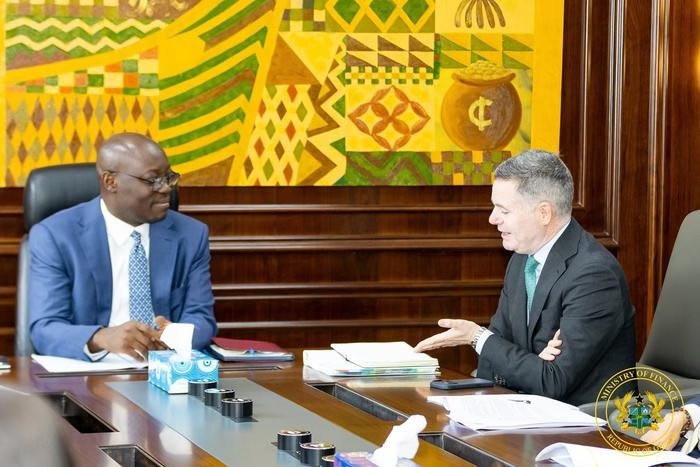
“56.4% of Ghanaians remain in poverty. And spatial disparities are widening,” Dr Taliercio O’Brien said.
The World Bank official said the figures point to a significant gap between Ghana’s overall economic performance and the everyday experiences of many citizens.
He noted that while the economy has recorded growth, the benefits have not been distributed widely enough to produce meaningful improvements in living standards across the population.
“… a disconnect between the headline growth that is yet to reach most of the population,” he remarked.
The World Bank’s assessment also identified the structure of Ghana’s economic growth as a major concern.
According to Dr Taliercio O’Brien, the sectors currently driving economic growth have limited capacity to absorb the growing number of people entering the labour market.
“Growth is led by sectors with limited employment absorption relative to its growing young population entering the labour market in the next decade,” he said.
The issue is particularly important given Ghana’s youthful population and the increasing number of young people expected to seek employment in the coming years.
The World Bank warned that without sufficient job creation, economic growth could continue to exist alongside high levels of poverty and limited improvements in household welfare.
Dr Taliercio O’Brien described the situation as “a structural imbalance that also demands urgent attention.”
The widening spatial disparities also point to differences in economic opportunities and living conditions across various parts of Ghana.
While some regions and communities may benefit more directly from economic activity, others continue to face significant challenges related to employment, income and access to opportunities.
The World Bank’s latest assessment therefore raises questions about the quality and inclusiveness of Ghana’s economic growth.
For economic expansion to have a broader impact, the institution suggests that greater attention will need to be paid to sectors capable of creating jobs and providing sustainable opportunities for the country’s growing working-age population.
The findings come as Ghana continues efforts to strengthen economic stability and improve living standards following recent economic challenges.
The World Bank’s 10th Ghana Economic Update is expected to provide further analysis of the country’s economic performance, poverty trends, employment challenges and the structural changes required to make growth more inclusive.
The latest warning underscores the importance of ensuring that economic growth translates into tangible improvements in the lives of ordinary Ghanaians, particularly young people entering the labour market.
With 56.4% of the population still reported to be living in poverty, the World Bank’s assessment highlights the need for policies that not only increase economic output but also create jobs, reduce regional disparities and expand opportunities for households across the country.