
|
Getting your Trinity Audio player ready...
|
The Executive Director of Africa Education Watch (Eduwatch), Kofi Asare, has rejected claims that examination malpractice in Ghana is declining, arguing that available data instead points to a significant increase in the problem.
Speaking on Joy FM’s Super Morning Show on Tuesday, September 15, Mr Asare said the figures available to Eduwatch show that examination malpractice has risen sharply in recent years.

According to him, the rate increased from about 0.9% in 2018 to 13.5% in 2024, before rising further to 14.8% in 2025.
“I disagree with the President’s assertion that examination malpractice is declining,” Mr Asare said.
He argued that the trend between 2024 and 2025 does not support claims of an improvement in the situation.
“Between 2024 and 2025, it did not decline. It will increase further from 13.5 percent to 14.8 percent. We are waiting for 2026 data,” he stated.
Eduwatch questions reliance on arrests
Mr Asare also disagreed with the suggestion that increased arrests of people involved in examination malpractice should be interpreted as evidence that the problem is declining.
He explained that Eduwatch measures progress based on the prevalence of examination malpractice rather than the number of arrests made.
“For us at Eduwatch, we see this as a behavioural challenge for which the solutions should be change in attitude and behaviour,” he said.
According to him, the organisation does not have comprehensive data on arrests to use that figure as the main measure of progress.
“We measure progress by the number of people participating in the fraud, not the number of people being arrested, because we don’t have data for that,” he added.
BECE malpractice figures raise concern
Mr Asare further pointed to data from the Basic Education Certificate Examination (BECE), arguing that malpractice linked to subject cancellations and entire results also increased significantly between 2024 and 2025.
“If you look at BECE, actually, malpractice level, subject cancellations, both entire results and then subject cancellations, actually doubled, more than doubled from 4.22 in 2024 to 28.95 percent in 2025,” he said.
He acknowledged that a decline was recorded in 2020 but maintained that the level of malpractice remains a concern when compared with more recent figures.
Mr Asare also raised concerns about the number of candidates affected by subject cancellations, saying more than 7,000 candidates had their results cancelled over subject-related examination malpractice.
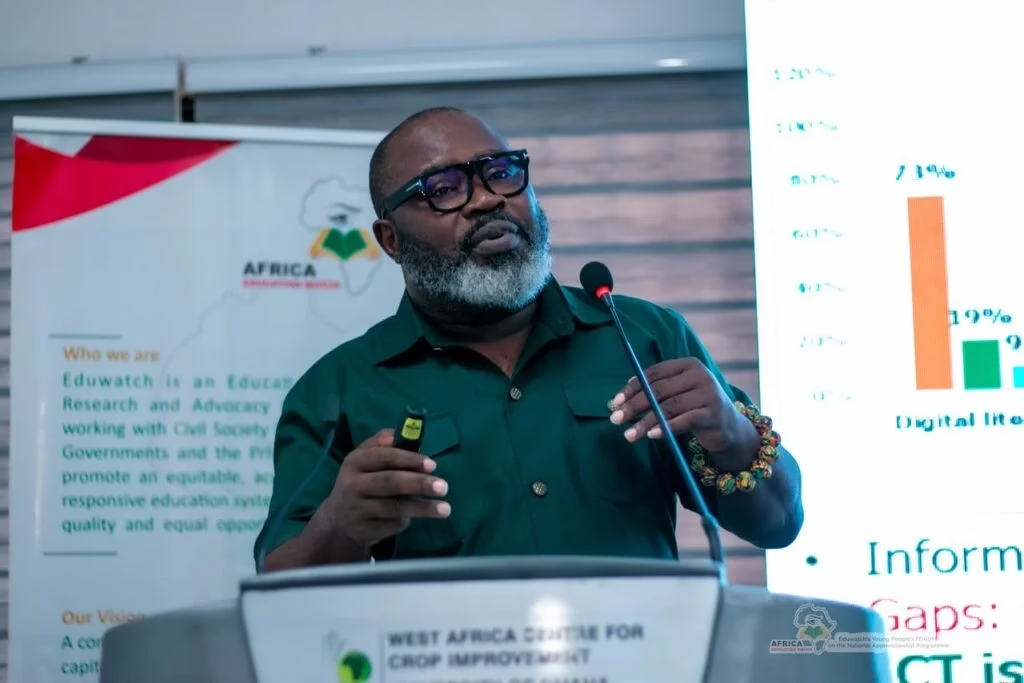
Call for behavioural change
The Eduwatch Executive Director said examination malpractice should be treated primarily as a behavioural challenge requiring changes in attitudes among students, parents, teachers and other stakeholders.
He maintained that simply increasing arrests may not address the underlying factors that encourage examination fraud.
Mr Asare said the eventual release of the 2026 examination malpractice data will provide an important basis for determining whether the trend has changed.
Until those figures become available, however, he maintained that the statistics currently available to Eduwatch do not support the claim that examination malpractice is declining.
Instead, he argued that the increase recorded between 2024 and 2025 should prompt education authorities to intensify efforts aimed at changing the attitudes and behaviours that contribute to examination malpractice in Ghana.