
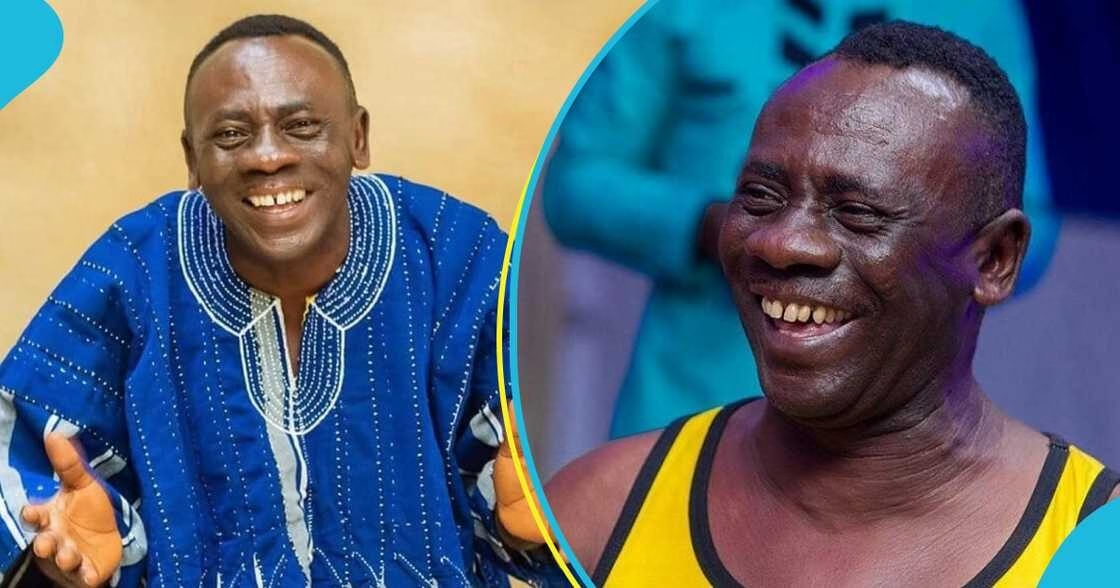
Renowned Kumawood actor Akrobeto has opened up about a difficult yet transformative decision he made regarding his son’s future, shedding light on the importance of alternative career paths beyond formal education.
Speaking in a video that has since gained attention online, the actor, known in private life as Akwasi Boadi, revealed that his third-born son faced significant academic challenges despite efforts to support him through senior high school.

According to Akrobeto, his son was determined to pursue university education, largely inspired by his siblings—one currently in university and another living abroad.
“My third-born wanted to attend university. I tried everything to put him through school, but he wasn’t academically gifted enough.
He wrote three different remedial exams and still didn’t pass,” he recounted.
Faced with this reality, Akrobeto explained that he had to make a tough but necessary decision to redirect his son’s path.
In search of guidance, he consulted the late Kwadwo Safo Kantanka, whose advice ultimately proved pivotal.
“I took him to Apostle Kantanka, and he advised my son to choose something else aside from formal education,” he said.
Taking this counsel seriously, Akrobeto and his son explored alternative options, eventually settling on vocational training.
The young man chose to learn phone repairs, a practical skill with growing demand in today’s technology-driven world.
He was enrolled in an apprenticeship program at China House in Kumasi, where he began his journey toward self-reliance.
Akrobeto supported his son financially during the early stages of the training, providing him with a weekly allowance to sustain him as he learned the trade.
“I used to send him GH₵100 every week,” he shared, highlighting the commitment he made to ensure his son had the resources needed to succeed.
However, what followed was both surprising and inspiring. After just eight months of training, his son informed him that he no longer needed financial support.
Having mastered the craft, he had become capable of repairing various types of mobile phones and was earning his own income.
“Can you imagine that after eight months, he told me to stop sending him money? He had mastered phone repairs and was capable of fixing any phone,” Akrobeto said with pride.
The story has since resonated with many Ghanaians, sparking conversations about the value of vocational skills and the need to recognize that success can be achieved through multiple pathways.
In a society where formal education is often seen as the primary route to achievement, Akrobeto’s experience highlights the importance of identifying individual strengths and nurturing them accordingly.
His message serves as both an inspiration and a reminder to parents and young people alike—that academic struggles do not define one’s future, and with the right guidance and determination, alternative paths can lead to meaningful success.