Nemesio Rubén Oseguera Cervantes, widely known as Nemesio Rubén Oseguera Cervantes or “El Mencho,” has died following a Mexican military operation in Jalisco state, marking the end of one of the most notorious chapters in Mexico’s drug war.
The 59-year-old leader of the Jalisco New Generation Cartel (CJNG) was wounded during a raid on Sunday, February 22, 2026, in the mountain town of Tapalpa. According to official reports, he died while being flown to Mexico City for medical treatment.
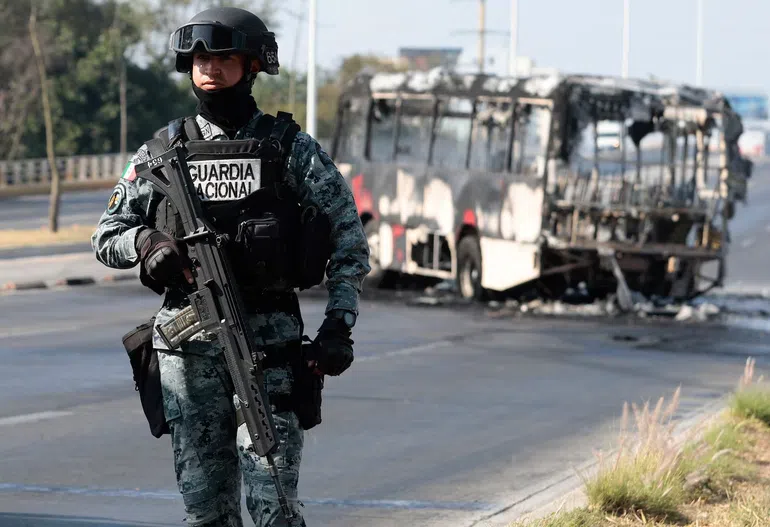
His death triggered immediate unrest across western Mexico, particularly in Jalisco, where burning vehicles were used to block highways — a tactic often associated with CJNG. Public transportation was suspended in parts of the state, schools were closed in several districts, and residents were urged to remain indoors. The city of Guadalajara, widely regarded as the cartel’s stronghold, fell unusually quiet.
The United States had offered a reward of up to $15 million for information leading to his capture. That reward ultimately went unclaimed.
US Deputy Secretary of State Christopher Landau described Oseguera as “one of the bloodiest and most ruthless drug kingpins.” The White House confirmed that American intelligence support assisted Mexican authorities during the operation.
Several cartel members were killed during the raid, while others reportedly died during transfer. Two suspects were arrested, and authorities seized armored vehicles and heavy weaponry. Members of Mexico’s armed forces were also injured in the confrontation.
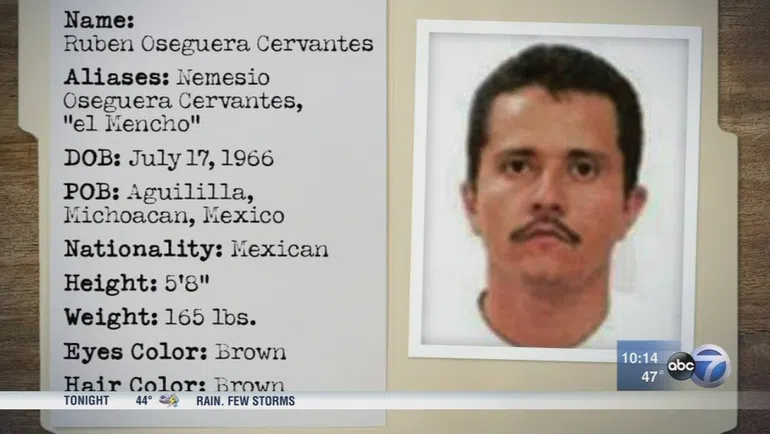
Born in Aguililla, Michoacán — a region long associated with drug trafficking — Oseguera’s early life reportedly included work as a police officer and avocado farmer. He later entered the United States illegally in the 1980s, where he was arrested on drug charges, deported, returned, and arrested again in 1992 before serving prison time and being deported a second time.
Upon returning to Mexico, he became involved with the Milenio Cartel. Around 2007, he co-founded CJNG alongside Érick Valencia Salazar, transforming it from a splinter group into one of Mexico’s most powerful criminal organizations.
US law enforcement agencies, including the FBI and the Drug Enforcement Administration, have long identified CJNG as a dominant force in trafficking cocaine, methamphetamine, heroin and fentanyl into the United States.
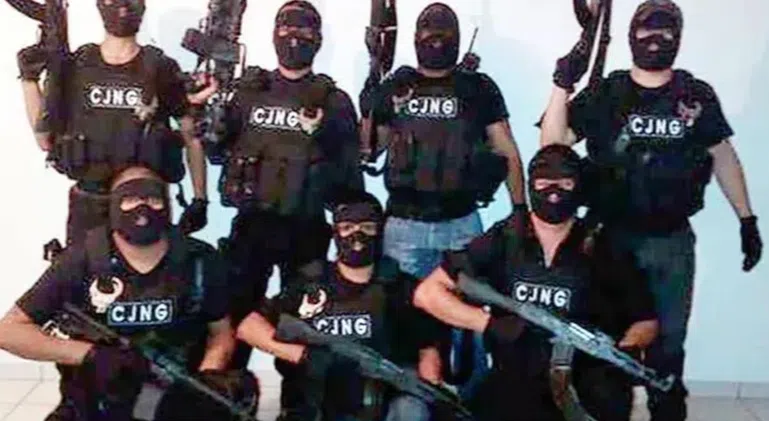
The cartel became notorious for its aggressive tactics, including deploying drones equipped with explosives and launching coordinated attacks on security forces. In 2020, CJNG carried out a high-profile assassination attempt on Mexico City’s police chief using heavy weaponry in a brazen urban assault. The target survived.
CJNG operated partly as a family-based network. His son, Rubén Oseguera González, known as “El Menchito,” was sentenced in the United States in March 2025 to life in prison plus 30 years on multiple drug trafficking charges.
His wife, Rosalinda González Valencia, was arrested in Mexico in 2021 on allegations of financial links to the cartel. Her brother, Abigael González Valencia, identified as a key financial operator, was also detained in earlier operations.
By the time security forces reached Tapalpa, much of Oseguera’s inner circle had already been weakened through arrests and prosecutions.
Security analysts warn that the power vacuum left by his death could lead to internal struggles among CJNG’s regional commanders. Past crackdowns on cartel leaders have often resulted in fragmentation and short-term spikes in violence.
The timing is particularly sensitive as Mexico prepares to co-host the 2026 FIFA World Cup, with Guadalajara scheduled as one of the host cities. Stability in Jalisco will be closely monitored in the coming months.
Mexican President Claudia Sheinbaum commended the security forces and urged calm following the operation.
While El Mencho’s death marks the end of an era for one of the world’s most feared criminal leaders, experts caution that dismantling the cartel’s broader network will require sustained efforts. Whether his absence brings lasting stability or sparks further violence remains uncertain.