|
Getting your Trinity Audio player ready...
|
The Bank of Ghana (BoG) has revoked the Dedicated Electronic Money Issuer (DEMI) licence of Zeepay Ghana Limited with immediate effect, citing multiple regulatory breaches and the company’s persistent failure to comply with directives issued by the central bank.
In a public notice dated July 14, 2026, the Bank of Ghana said the decision was taken after determining that Zeepay’s continued operations posed a risk to users, service providers and the country’s payment ecosystem.
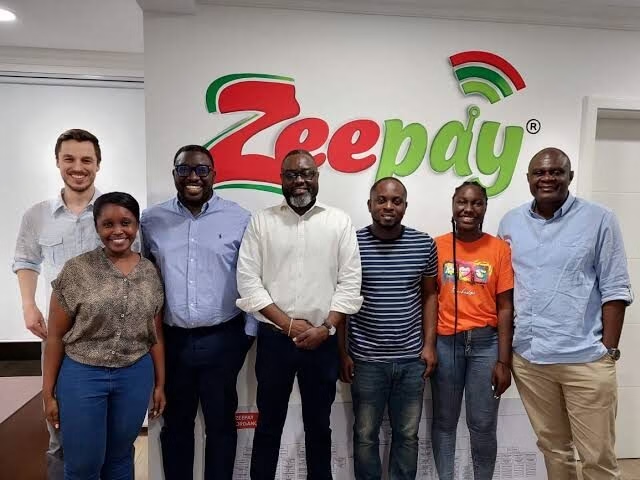
According to the central bank, Zeepay breached provisions of the Payment Systems and Services Act, 2019 (Act 987) by issuing electronic money without maintaining the required cash backing. The regulator said this created a negative variance between the value of electronic money issued and the funds backing those balances, exposing customers and the financial system to significant risk.
The Bank of Ghana further stated that Zeepay repeatedly failed to comply with directives requiring the company to inject sufficient funds to fully back its electronic money balances and to wind down its e-money issuance business.
“The continuous use of its DEMI licence constitutes a threat to the stability of the payment system,” the central bank said.
The revocation marks another setback for the fintech company, which had established itself as one of Africa’s leading cross-border payment providers, operating across more than 20 countries on the continent.
Zeepay has faced increasing legal and financial challenges in recent months.
In April 2026, the Commercial Division of the High Court ordered Zeepay and its founder and Chief Executive Officer, Andrew Takyi-Appiah, to pay more than US$11.6 million to a customer after finding that the company had failed to execute fund transfers.
Justice Afi Agbanu Kudomor granted summary judgment after concluding that the defendants had failed to present a reasonable defence. The court also held Takyi-Appiah personally liable after evidence showed that a significant portion of the disputed funds had been transferred into his personal Mobile Money wallet.
The company’s governance challenges also deepened earlier this year.
Its Chief Financial Officer resigned in February 2026, citing what were described as material weaknesses and abuse in treasury operations. Around the same period, international audit firm Ernst & Young withdrew from conducting Zeepay’s 2024 audit, citing serious concerns regarding the quality and reliability of information provided by the company.
The latest regulatory action follows previous sanctions imposed by the Bank of Ghana.
In 2023, the central bank fined Zeepay and temporarily suspended its foreign exchange licence after the company breached foreign exchange regulations.
Beyond Ghana, Zeepay’s Barbadian subsidiary, Zeemoney, also had its licence suspended by the Central Bank of Barbados before applying for voluntary liquidation.
The company is additionally facing a winding-up petition filed by creditor Obsidian Achernar Ltd, which is seeking the recovery of an alleged unpaid debt of US$1.22 million.
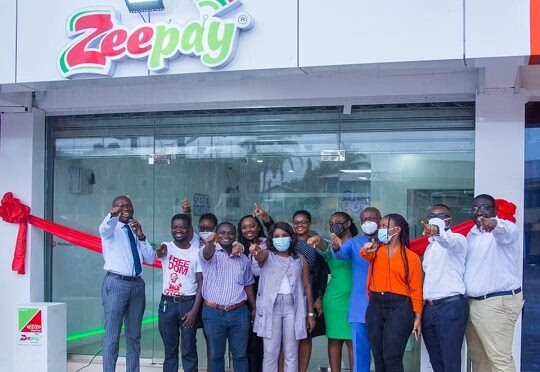
The Bank of Ghana has advised all affected Zeepay wallet holders, merchants and agents to contact its Complaints Office through its dedicated telephone line or official email address for assistance.
Under the Payment Systems and Services Act, any electronic money issuer whose licence is revoked is required to refund customers the value of all electronic money held within 10 days.
The Bank of Ghana reaffirmed its commitment to maintaining financial stability, protecting consumers and preserving the integrity of Ghana’s payment system, adding that it would continue to take decisive regulatory action against institutions that fail to comply with established laws and supervisory requirements.