
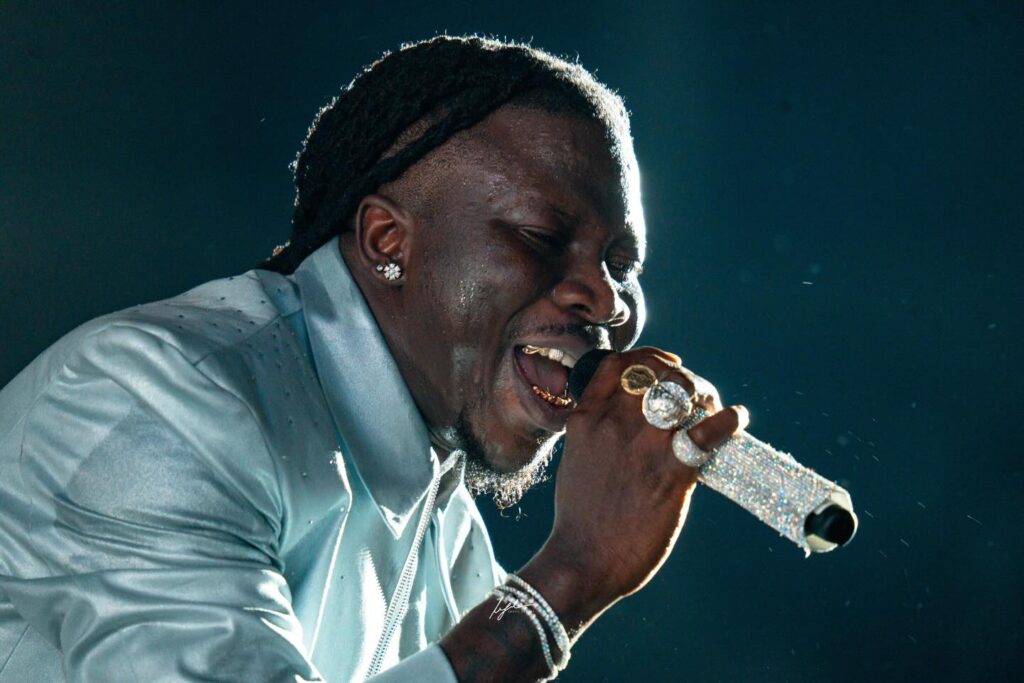
Ghanaian dancehall musician Stonebwoy has added his voice to the growing national debate surrounding the proposed renaming of Kotoka International Airport, urging government and policymakers to ensure that any decision taken serves the broader national interest and reflects historical balance.
Public discussion intensified after the Majority in Parliament confirmed that the government is considering changing the name of the country’s main international airport to Accra International Airport.
Since the announcement, opinions from political figures, historians, civil society groups, and members of the public have poured in, turning the proposal into a nationwide conversation.
Joining the debate, the award-winning artiste shared a measured and conditional perspective. Writing on X (formerly Twitter) on February 4, 2026, Stonebwoy stated that he would not oppose the renaming outright, provided the move delivers tangible benefits to the nation and projects Ghana positively on the global stage.
“I believe the reasons are clear and politically sound. They appear very nationalistic,” the musician wrote, acknowledging the arguments being advanced in favour of the change.
However, he cautioned that symbolism alone should not drive such a major decision. According to Stonebwoy, if the renaming does not lead to any form of upliftment or national progress, then it would be difficult to justify.
“If the change does not bring any upliftment, then I would not support it. But if it promotes progress and projects a positive image of the country, then I am in favour,” he added.
Stonebwoy further stressed that renaming a landmark as significant as the country’s main international airport must be backed by strong reasoning and thoughtful consideration. In his view, the historical context behind the airport’s current name should not be ignored.
He noted that the airport was named after General Emmanuel Kwasi Kotoka for reasons tied to Ghana’s political history, suggesting that the decision at the time reflected perceived contributions made by the individual.
“I do not want to go too deeply into it because I do not believe any human being is entirely evil throughout their life. There must have been some positive aspects,” Stonebwoy stated.
He continued by arguing that the very fact the airport was named after Kotoka indicates that there were reasons deemed valid at the time. Therefore, any move to change the name should be supported by an equally compelling justification, rather than emotional or partisan motivations.

“The fact that the airport was named after him suggests there were reasons for that choice. So, if the name is to be changed, it should be done for another equally good reason,” he said.
Stonebwoy’s comments reflect a broader sentiment being expressed by many Ghanaians — a call for balance, historical awareness, and national unity as the country debates the future of one of its most prominent national symbols.
As discussions continue in Parliament and across the public sphere, the government is expected to provide further clarification on the rationale behind the proposed renaming and whether consultations will be expanded to include broader stakeholder input.