President John Dramani Mahama has directed the Majority Leader, Mahama Ayariga, and the Majority Chief Whip, Rockson-Nelson Dafeamekpor, to suspend and withdraw their Private Members’ Bill seeking to abolish the Office of the Special Prosecutor (OSP).
The directive followed growing national debate sparked by the proposed legislation, officially titled the Office of the Special Prosecutor (Repeal) Bill, 2025.
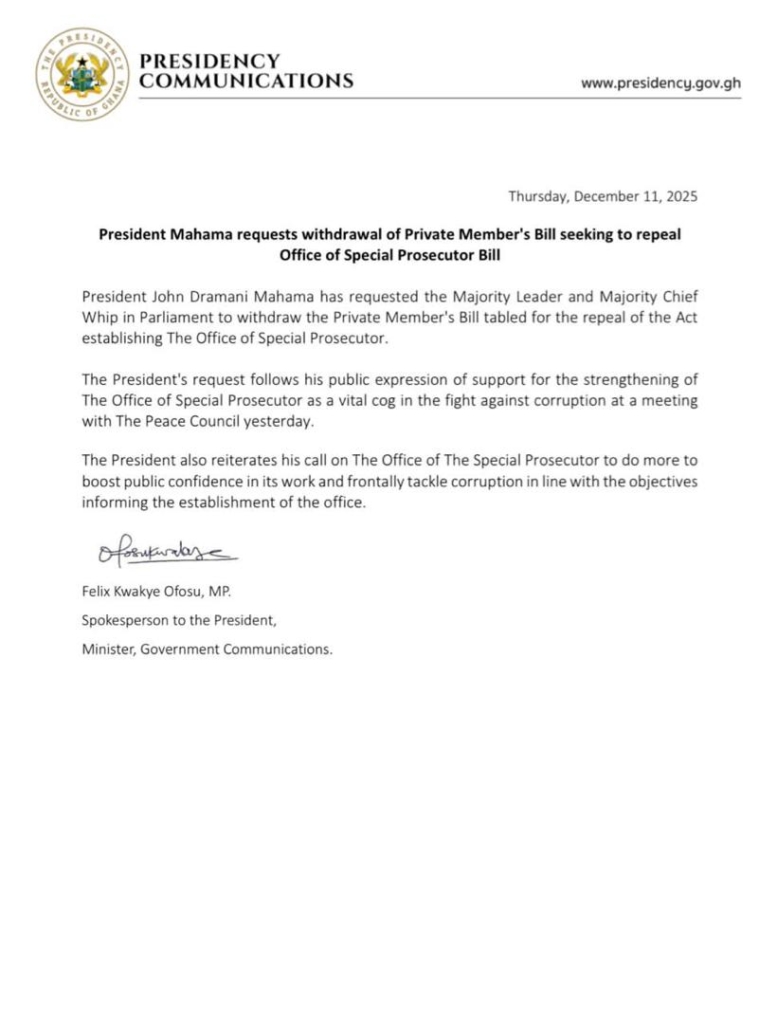
The development was announced in a statement issued on Thursday, December 11, by Felix Kwakye Ofosu, Spokesperson to the President and Minister for Government Communications.
According to the statement, President Mahama’s request aligns with his consistent public stance that the OSP remains a crucial institution in Ghana’s anti-corruption architecture.
“President John Dramani Mahama has requested the Majority Leader and Majority Chief Whip in Parliament to withdraw the Private Member’s Bill tabled for the repeal of the Act establishing The Office of Special Prosecutor,” the statement said.
It added that the directive followed the President’s reaffirmation of support for the OSP during a meeting with the National Peace Council a day earlier.
The President, who has previously emphasised the need to fortify anti-corruption institutions, reiterated that the OSP should be strengthened—not abolished.
He stressed that the office must be given the necessary time and resources to deliver effectively on its mandate, especially in restoring public trust and ensuring accountability in public service.
“The President also reiterates his call on The Office of The Special Prosecutor to do more to boost public confidence in its work and frontally tackle corruption,” the statement added.
The move to repeal the OSP Act had been justified by its proponents on grounds of structural and constitutional challenges. The draft bill argued that the OSP had struggled with operational inefficiencies, duplication of prosecutorial duties with the Attorney-General’s Office, and limited impact relative to its budget allocations.
The accompanying memorandum further highlighted what it described as jurisdictional conflicts and administrative overheads that have allegedly hindered the OSP’s ability to function effectively.
Advocates of the repeal maintained that returning full prosecutorial powers to the Attorney-General, as originally stipulated in Article 88 of the Constitution, would streamline Ghana’s fight against corruption.
They proposed replacing the OSP with a specialised anti-corruption division within the Attorney-General’s Office, which they argued would present a more cost-effective and integrated model.
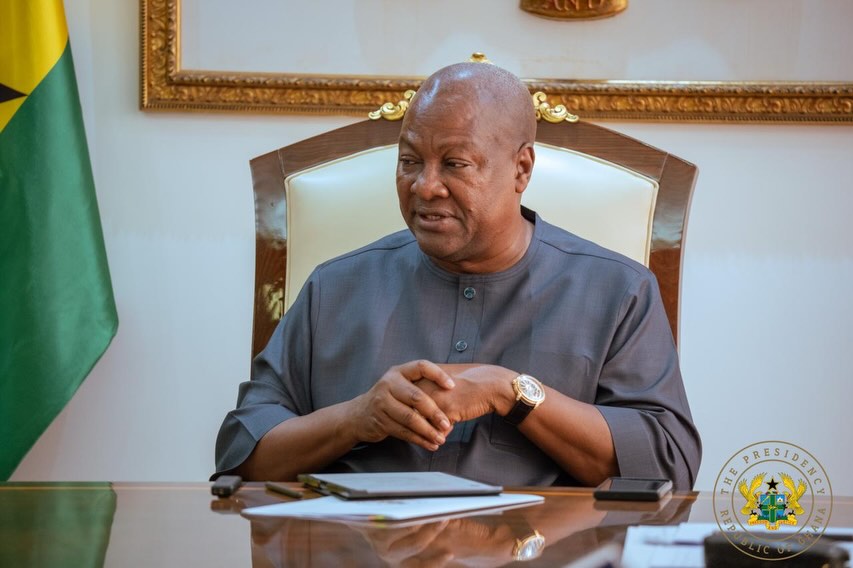
However, President Mahama’s intervention makes clear that his administration remains committed to preserving the OSP as an independent body. His directive significantly reduces the likelihood of the bill progressing through Parliament in its current form.
The bill had also outlined transitional arrangements for absorbing the OSP’s operations into the Attorney-General’s structure, but with the President’s latest directive, the future of such proposals appears uncertain.
For now, the Office of the Special Prosecutor remains intact, as the government signals a renewed commitment to enhancing its performance rather than abolishing it.