
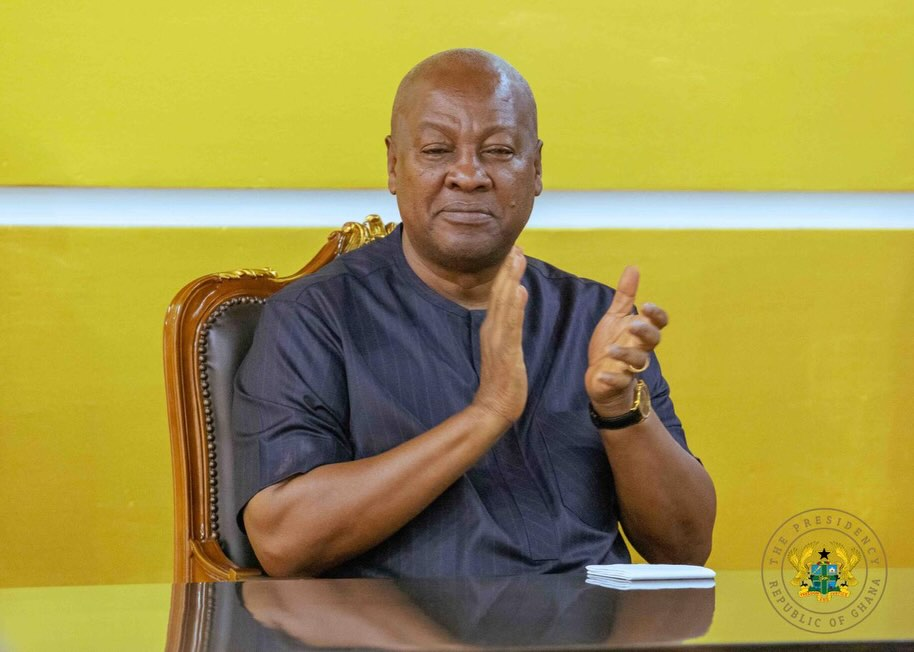
President John Dramani Mahama has emphasised the need for farmer-centred policies in Ghana’s cocoa sector, drawing on his personal experience as a cocoa farmer to illustrate the real impact of government pricing decisions.
Speaking at the maiden Ghana Tree Crops Authority Investment Summit and Exhibition on Tuesday, February 17, the President said he understands first-hand the economic pressures facing cocoa farmers, particularly amid recent volatility in global cocoa prices.

His comments follow controversial reforms in the cocoa economy, where the farmgate price was reduced from GH¢3,625 to GH¢2,587 per bag to align with fluctuations on the international market.
“Nana Kwebu Ewusi gave me 50 acres of land, and I planted cocoa on the 50 acres, so I am a cocoa farmer. So when the price is reduced by the government, it affects me too. I want to be able to empathise with farmers so that when we take any policy decision, we know that it has an effect on farmers and we feel it ourselves,” he stated.
Ghana remains the world’s second-largest cocoa producer after Côte d’Ivoire, and cocoa continues to serve as a major foreign exchange earner for the country. The sector supports more than 800,000 farm households and provides livelihoods for millions across farming communities, transport networks, and processing industries.
Recent developments in the global cocoa market have intensified challenges for producers and policymakers. Cocoa prices surged to historic highs of over $10,000 per tonne in 2024 before declining significantly due to improved production forecasts and broader market corrections. These fluctuations have created uncertainty within Ghana’s cocoa economy.
President Mahama stressed that government decisions on cocoa pricing and structural reforms must reflect the lived realities of farmers, whose incomes depend largely on producer price adjustments announced annually by the Ghana Cocoa Board.

He noted that policies affecting cocoa farmers have direct consequences for rural livelihoods, access to education, healthcare, and overall household welfare. According to him, reforms in the sector must prioritise sustainability, fairness, and long-term growth rather than short-term market reactions.
The summit aims to attract investment into key tree crops including cocoa, cashew, rubber, coconut, and oil palm as part of broader efforts to diversify Ghana’s agricultural base and enhance value addition.
Reaffirming his administration’s commitment, Mahama pledged to strengthen the cocoa sector through improved pricing mechanisms, increased productivity, and measures to ensure farmers receive fair returns for their produce.
He concluded that aligning national policy with the everyday experiences of farmers will be critical to safeguarding the future of Ghana’s cocoa industry and maintaining its competitiveness on the global stage.